A scholar, a creative, a social worker - hailing from Fayetteville, NC.

The Case Assessment Report is used as an embedded measure for CSWE Competency 7 (Assess individuals, families, and groups.).

This Case Assessment Report was an assignment for my SWK 622: Social Work with Individuals course. This assignment required me to apply social work assessment principles and guidelines to a case from my internship. I gained practice with researching and selecting an appropriate standardized measure to use to assess my client.

The pdf of my paper can be found here.

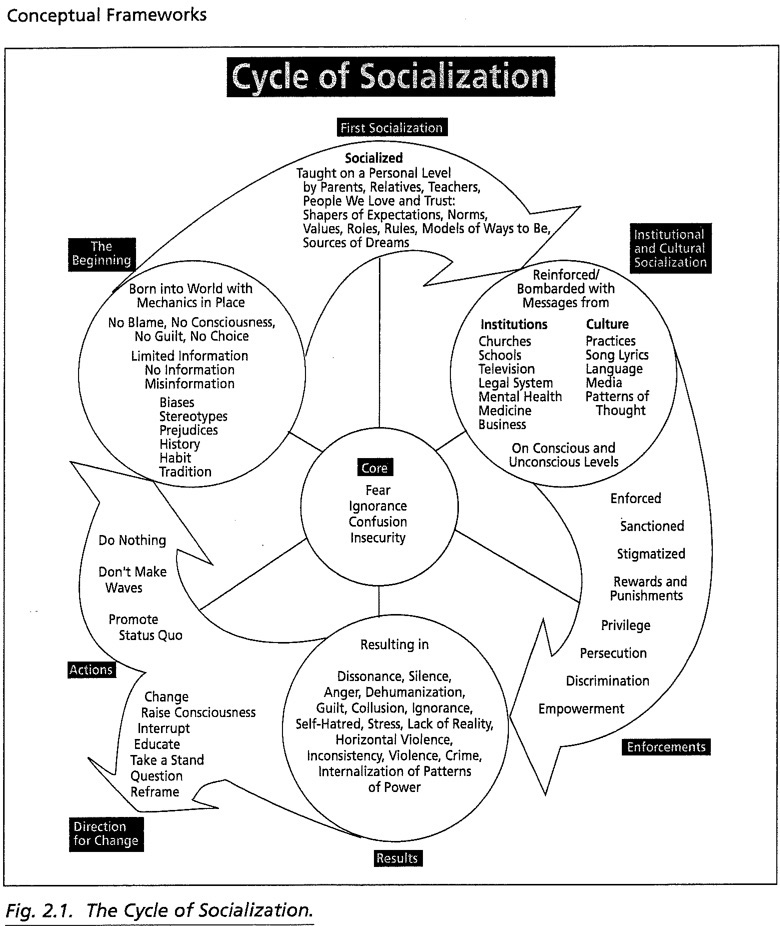
Harro, Bobbie (2000). The cycle of socialization. In M. Adams, W. Blumenfeld, R. Castañeda, H. Hackman, M. Peteres & X. Zúñiga (eds.) Readings for diversity and social justice: An anthology on racism, sexism, anti-semitism, heterosexism, classism, and ableism (pp. 15-21). New York: Routledge.

I read Bobbie Harro’s Cycle of Socialization in SWK 624: Social Work Practice and Human Diversity. It was central to the composition of my Cycle of Socialization paper in which I analyzed a time I was prejudiced toward, stereotyped, or discriminated against others. I utilized Harro’s model to try to understand how my behaviors came to be.

This is a reading that really stuck with me. It provided a framework to more clearly understand that people do not come to be whoever they are, for better or for worse, in a vacuum. It provides space for compassion or maybe even forgiveness for others we may find ourselves at odds with.

I have shared this article with friends across multiple disciplines since first reading it and it has contributed to insightful and reflective conversations.

Coates, T. (2015). Between the World and Me. United States: Random House Publishing Group.

During the troubling summer of 2020, I spent about a week in Baltimore, MD, the hometown of author Ta-Nehisi Coates. I had not read “Between the World and Me” yet, though it had been on my shelf for a few years. While in Baltimore I took note of the Baltimore Police Department helicopter that seemed to pass by overhead more than once during my week stay. While walking through a popular area near the inner harbor to get food, I couldn’t help but to take note of the all black Baltimore PD mobile command station, inconveniently parked right in the middle of the thoroughfare.

I picked up Coates’ “Between the World and Me” for the same reason I picked up Baldwin’s “The Fire Next Time” that summer. I wanted to hear what other Black voices had to say about the experience of being Black in the face of racism and oppression in this country.

Coates’ work is a letter to his 15-year-old son, who like him will grow to be a Black man in America. Coates addresses the murders of Eric Garner, Renisha McBride, Tamir Rice and numerous other Black people cut down by state violence. Like Monique W. Morris, he also speaks to the school to prison pipeline that targets Black children with precision.

When our elders presented school to us, they did not present it as a place of high learning but as a means of escape from death and penal warehousing.

Ta-Nehisi Coates, Between the World and Me

Coates talks about what it was like growing up in Baltimore just out of reach of the promise of Washington D.C. where he had to find his place somewhere between the violent streets and the violent public school system. This reminded me of my time working in West Charlotte High School which sits within an 8 mile radius outside of Uptown Charlotte. Despite being so near to a city center that is home to not one but two professional sports arenas, museums and galleries, concert venues, upscale restaurants, etc – my students lived in an area with one of the highest crime and poverty rates. A few years before I started working there, the graduation rate was an abysmal 58%. Coates notes that 60% of Black men who drop out of school will go to jail. I’m thinking about too many of my students who meet that statistic. Too many of my students who had to choose between the violence in the street or the violence in the classrooms.

Baldwin, J. (2013). The Fire Next Time. United States: Knopf Doubleday Publishing Group.

I read “The Fire Next Time” over the summer of 2020 just before starting my second and final year of the JMSW program. This particular summer saw the murder of Ahmaud Arbery, George Floyd, and intensified scrutiny over the death of Breonna Taylor.

There was so much raw tension and pain. I had the idea to create community forums in response to the murder of Ahmaud Arbery. I attended a number of local protests. I even got a chance to go home and see evidence of resistance in my own hometown.

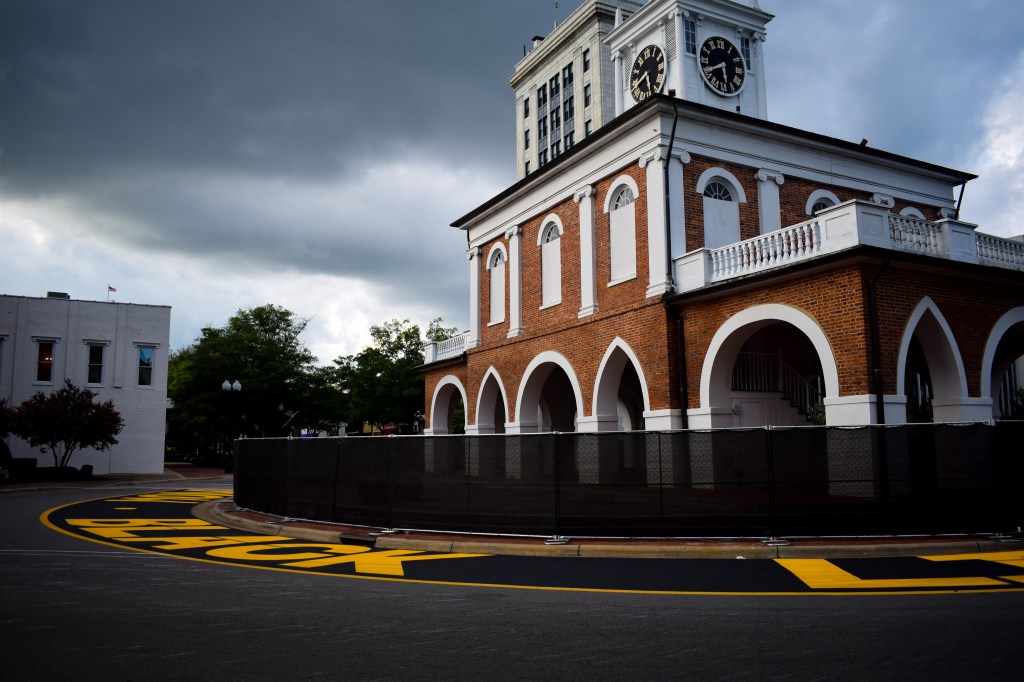
One of my favorite photos I’ve ever taken. The words “Black Lives Do Matter” painted around the Market House, an icon of my hometown, Fayetteville, North Carolina. Historically, the Market House was a place where enslaved people were sold, along with produce and other goods.

I was watching the rebuke of white supremacy and racism play out across America and the world via social media. One of the videos that always seems to make its rounds when race relations becomes a focus of American discourse was this of James Baldwin:

“The Fire Next Time” is the first work by Baldwin I’ve ever read. I feel ashamed to say that. I have known that he was a literary great and certainly part of the Black canon but I had never been prompted to read his work. I felt that prompting in the summer of 2020 with a desire to learn what ancestors had to see and teach about our common struggle against white supremacy.

The essays in “The Fire Next Time” read almost like an anthropological work. Baldwin’s frank, sometimes blunt assertions of the nature of Black and white people in America gave language and validation to some of the very same relations playing out today. Many of the pages are dog eared, highlighted, underlined, and annotated. A concept that I come back to time and time again is having a sort of compassion for white people, no matter the slight, the microaggression, or the outright malice that may be levied against Black people. In a sense, it feels akin to the NASW ethical principle of respecting the dignity and worth of a person.

Morris, M. (n.d.). Pushout: The Criminalization of Black Girls in Schools. United States: New Press.

I first became aware of Pushout while working at West Charlotte High School. Some of my students were reading it in their English class. The cover left an impression and the content seemed to really have my students fired up.

When seeking to write a policy analysis paper about zero tolerance policies in schools for SWK 621: Foundations of Social Work and Social Policy, Monique W. Morris’s Pushout is one of the first resources I turned to.

Morris lays out the systemic criminalization of Black girls within the public school system. Through an analysis of history, quantitative and poignant qualitative research, Morris brings the reality of education as a Black girl to the pages of “Pushout.”

As a Black woman who has only ever experienced public education and is interested in Black generational trauma specifically focused on working with adolescents, this reading helped me to conceptualize my own experiences growing up as well as what I observed working in a high school and even interning with the Guilford County Reentry Council.

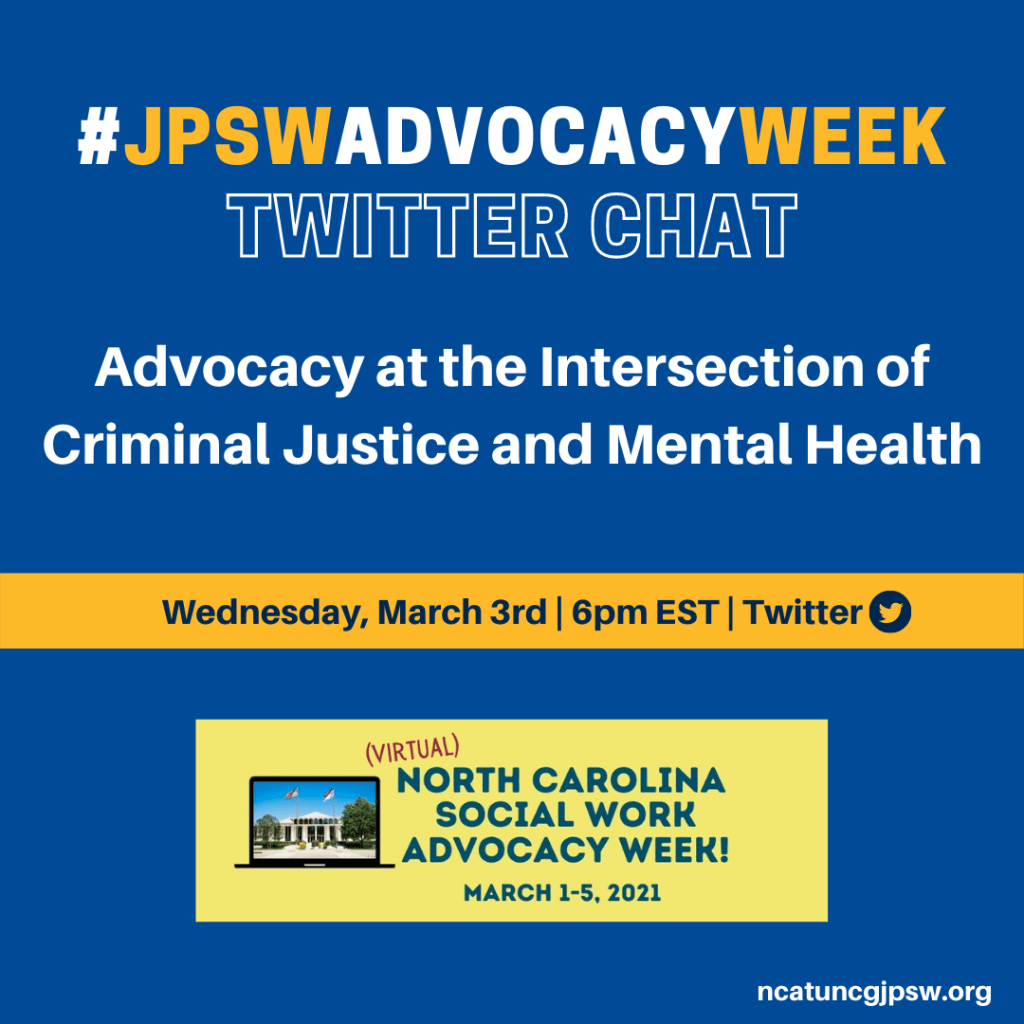
In recognition of the 2021 NASW NC Advocacy Week, Professor Jennifer Cobb, with support from Dr. Carmen Monico, led students in thinking through how we could participate. We formed various committees dedicated to various forms of advocacy centered around mental health and criminal justice reform. I joined the social media committee. My contribution was crafting questions and hosting an hour long Twitter Chat under the hashtag of #JPSWAdvocacyWeek (Joint Programs of Social Work Advocacy Week).

I was invited by Brittany Privott, a regional representative with the College Foundation of North Carolina (CFNC) to sit on a panel entitled “Serving African American and Black American Students through Admissions, Recruitment, and Success.” This panel sought to provide ways that North Carolina community colleges could better recruit and serve Black students. I was invited to serve on this panel because of my work as a College Adviser at West Charlotte High School and my success at partnering with Central Piedmont Community College to help my students continue their education.

The panel took place January 26, 2021 and had nearly 200 people register to attend.

A recording of the panel can be viewed at the top of the page.

Click the image to see the slideshow I designed for our orientation session.

I was elected President of the Joint Master of Social Work Student Organization (JMSWSO) in July 2020. One of my first responsibilities was to get my new exec board prepared to welcome new JMSW students at the new student orientation in August 2020.

The JMSWSO prepared a session for orientation aimed at introducing ourselves and our roles, recruiting to fill available positions on the board, and answering questions about the program that new students may have.

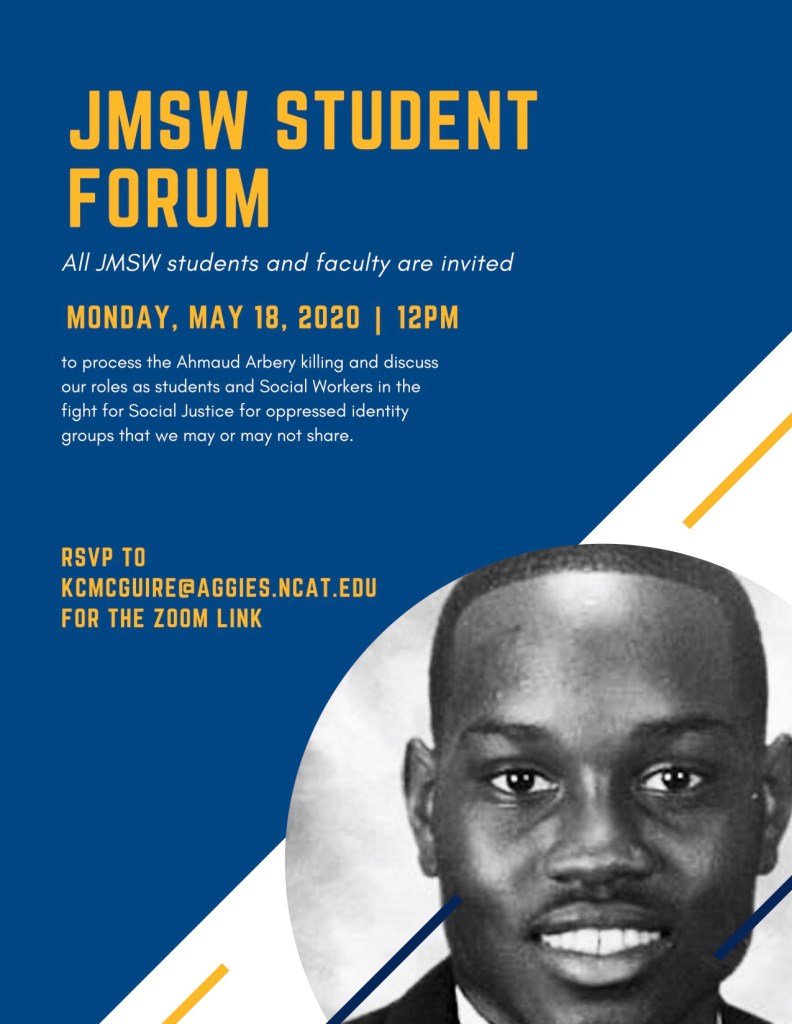
In light of the murder of Ahmaud Arbery, multiple students expressed interest in having a space to process the tragedy and our roles as Social Workers in relation to these all too common occurrences. I pitched the idea of a community forum in a small meeting and my classmates and professor were supportive.

With the collaboration and support of my colleague, Destiney Springs-Walker, and multiple faculty in my program, we hosted two community forums in May 2020. The first forum was crafted with the intention of creating a safe space for grieving and community support for Black students and faculty. We created an agenda and guiding questions. The second forum was a program wide forum crafted with the intention of processing and understanding our individual and collective roles as Social Workers. We worked together to create an agenda with supplemental reading and tools for participants of the forum. One of these tools shared by Professor Maruka Rivers was the silk ring theory.

From these two forums came fruitful follow up conversations and reflections on personal growth. I was encouraged that both colleagues and professors reached out to me to continue processing.

Additional note: There was a personal sense of urgency to proceed with the forums despite the personal distress as a Black woman witnessing another public Black lynching. I was advised to take time and reconsider having the program wide forum so soon with emotions being so fresh. However my biggest impetus was knowing American history and especially American summers. About a week later George Floyd was killed.

Here you’ll find a case analysis I completed for my Advanced Clinical Practice course.

The Case Analysis is used as an embedded measure for the following CSWE competencies:
3. Advance human rights and social, economic, and environmental justice.
6. Engage with individuals, families, and groups
7. Assess individuals, families, and groups.
8. Intervene with individuals, families, and groups.

The case vignette is below. The pdf of the paper is attached here.

“Helga” is a 35-year-old female with a graduate degree in sociology who describes herself as a “black woman who is very spiritual, but not religious.” She was born and raised in Germany but came to live in NC during her late teens. She relates that she has never felt “at home” since she left Germany, but that there is now nothing there for her to return to. She frequently mentions how lonely and isolated she feels. There are no friends in her life except one person who lives nearby, no intimate relationships, and she feels a deep sense of rejection. She is currently employed as a part-time instructor at a local community college.

Helga has a history of multiple inpatient behavioral health hospitalizations due to marked feelings of worthlessness, self-injurious (cutting) behaviors, and several attempts to end her own life. Her last hospitalization was one year ago and since discharge she has regularly attended outpatient individual and group therapy but its been about a month since she has been to her group.

Helga also describes an onset of acute anxiety when a lump was discovered in her throat approximately eighteen months ago. This was an extremely stressful period as the medical consequences of the lump were initially unknown, although the lump was later removed and found to be benign. She describes a continued intense fear of making mistakes and being responsible for “something bad happening.” For example, she worries that her cat will go missing should she leave the door open. She reluctantly shares with you that she is engaging in a variety of behaviors such as repeatedly checking doors, locks, and windows before she leaves the house or goes to bed to make sure that they are secured.

Helga relates the following to you: “I just dread getting up every morning. Everything seems like such a chore. I’m afraid that anything I do will turn to failure. I see no real sense in going on. I have constant thoughts of ending my life, but I am not sure how I would do that or if I really even want to. I’m surely no use to anyone around me. I just feel so worthless, rotten, and full of guilt and hatred for myself. I hear a voice in my head, like my consciousness, telling me that I’m “no good” over and over again. No matter what I do or try, I just can’t see any light at the end of that long, dark, cold, scary tunnel. I look forward to death, because then I won’t have to suffer anymore.” Helga tells you that she has one good friend that lives near her but otherwise she has few supports. She does tell you that she goes to church on occasion. She says that she enjoys listening to music and that she really like eating German foods. She cooks sometimes but doesn’t like to do that just for one person. She does not like going to the hospital and does not want to go back. She gets along well with her therapist and says that the group she attends is “okay.” She has a hard time feeling connected to others.