Coates, T. (2015). Between the World and Me. United States: Random House Publishing Group.

During the troubling summer of 2020, I spent about a week in Baltimore, MD, the hometown of author Ta-Nehisi Coates. I had not read “Between the World and Me” yet, though it had been on my shelf for a few years. While in Baltimore I took note of the Baltimore Police Department helicopter that seemed to pass by overhead more than once during my week stay. While walking through a popular area near the inner harbor to get food, I couldn’t help but to take note of the all black Baltimore PD mobile command station, inconveniently parked right in the middle of the thoroughfare.

I picked up Coates’ “Between the World and Me” for the same reason I picked up Baldwin’s “The Fire Next Time” that summer. I wanted to hear what other Black voices had to say about the experience of being Black in the face of racism and oppression in this country.

Coates’ work is a letter to his 15-year-old son, who like him will grow to be a Black man in America. Coates addresses the murders of Eric Garner, Renisha McBride, Tamir Rice and numerous other Black people cut down by state violence. Like Monique W. Morris, he also speaks to the school to prison pipeline that targets Black children with precision.

When our elders presented school to us, they did not present it as a place of high learning but as a means of escape from death and penal warehousing.

Ta-Nehisi Coates, Between the World and Me

Coates talks about what it was like growing up in Baltimore just out of reach of the promise of Washington D.C. where he had to find his place somewhere between the violent streets and the violent public school system. This reminded me of my time working in West Charlotte High School which sits within an 8 mile radius outside of Uptown Charlotte. Despite being so near to a city center that is home to not one but two professional sports arenas, museums and galleries, concert venues, upscale restaurants, etc – my students lived in an area with one of the highest crime and poverty rates. A few years before I started working there, the graduation rate was an abysmal 58%. Coates notes that 60% of Black men who drop out of school will go to jail. I’m thinking about too many of my students who meet that statistic. Too many of my students who had to choose between the violence in the street or the violence in the classrooms.
Baldwin, J. (2013). The Fire Next Time. United States: Knopf Doubleday Publishing Group.

I read “The Fire Next Time” over the summer of 2020 just before starting my second and final year of the JMSW program. This particular summer saw the murder of Ahmaud Arbery, George Floyd, and intensified scrutiny over the death of Breonna Taylor.

There was so much raw tension and pain. I had the idea to create community forums in response to the murder of Ahmaud Arbery. I attended a number of local protests. I even got a chance to go home and see evidence of resistance in my own hometown.

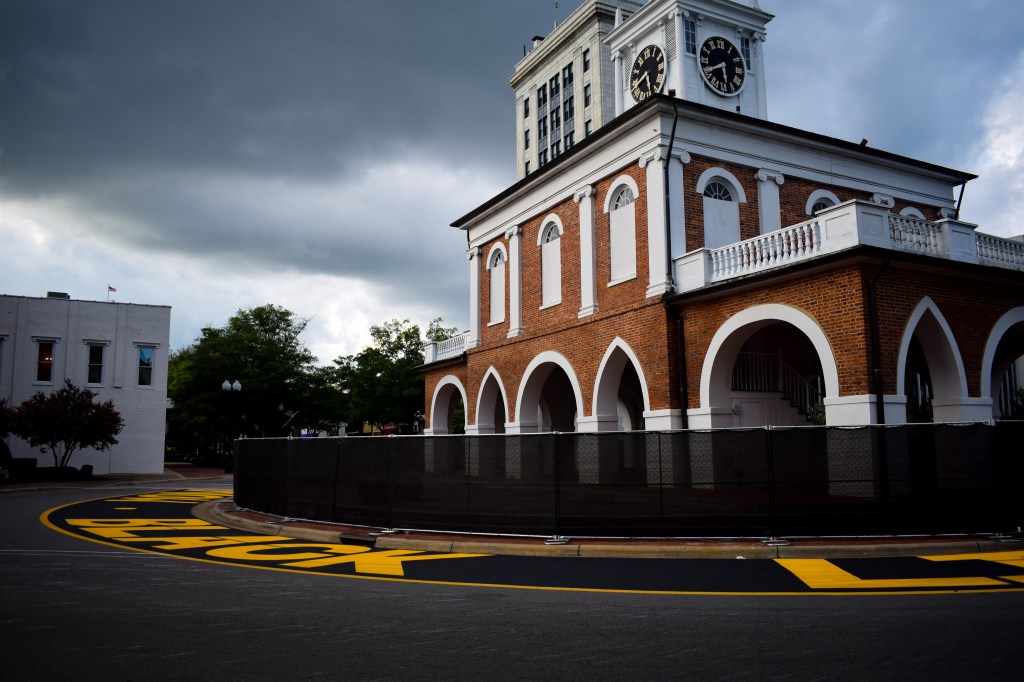
One of my favorite photos I’ve ever taken. The words “Black Lives Do Matter” painted around the Market House, an icon of my hometown, Fayetteville, North Carolina. Historically, the Market House was a place where enslaved people were sold, along with produce and other goods.

I was watching the rebuke of white supremacy and racism play out across America and the world via social media. One of the videos that always seems to make its rounds when race relations becomes a focus of American discourse was this of James Baldwin:

“The Fire Next Time” is the first work by Baldwin I’ve ever read. I feel ashamed to say that. I have known that he was a literary great and certainly part of the Black canon but I had never been prompted to read his work. I felt that prompting in the summer of 2020 with a desire to learn what ancestors had to see and teach about our common struggle against white supremacy.

The essays in “The Fire Next Time” read almost like an anthropological work. Baldwin’s frank, sometimes blunt assertions of the nature of Black and white people in America gave language and validation to some of the very same relations playing out today. Many of the pages are dog eared, highlighted, underlined, and annotated. A concept that I come back to time and time again is having a sort of compassion for white people, no matter the slight, the microaggression, or the outright malice that may be levied against Black people. In a sense, it feels akin to the NASW ethical principle of respecting the dignity and worth of a person.

Morris, M. (n.d.). Pushout: The Criminalization of Black Girls in Schools. United States: New Press.

I first became aware of Pushout while working at West Charlotte High School. Some of my students were reading it in their English class. The cover left an impression and the content seemed to really have my students fired up.

When seeking to write a policy analysis paper about zero tolerance policies in schools for SWK 621: Foundations of Social Work and Social Policy, Monique W. Morris’s Pushout is one of the first resources I turned to.

Morris lays out the systemic criminalization of Black girls within the public school system. Through an analysis of history, quantitative and poignant qualitative research, Morris brings the reality of education as a Black girl to the pages of “Pushout.”

As a Black woman who has only ever experienced public education and is interested in Black generational trauma specifically focused on working with adolescents, this reading helped me to conceptualize my own experiences growing up as well as what I observed working in a high school and even interning with the Guilford County Reentry Council.